JOpt Platform overview
The JOpt Platform is the container stack in which JOpt.TourOptimizer runs in auth mode. It adds sign-in and tenants, plans and licenses per tenant, a job queue shared by several TourOptimizer copies, geocoding and road distances through GeoCoderRouter, and the operations around them: health checks, metrics, backups and a release flow for the images. What TourOptimizer itself does, in both modes, is described in the JOpt.TourOptimizer section.
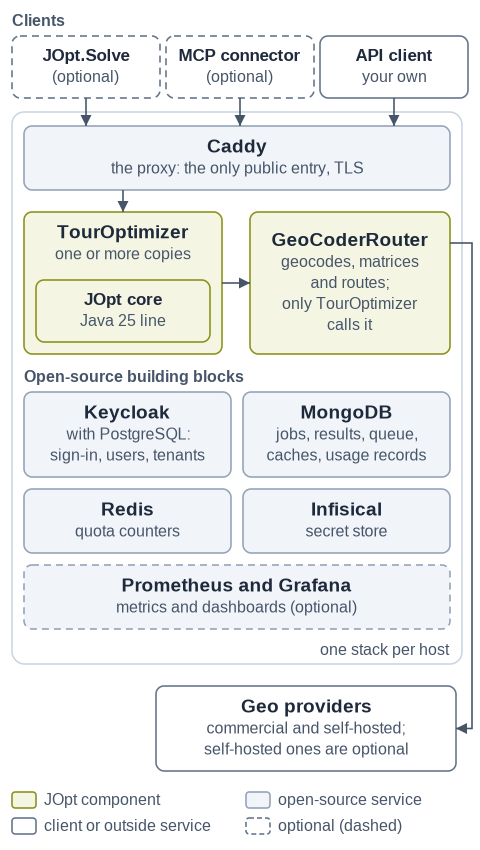
The diagram opens full size on click.
The clients reach the stack only through the proxy, Caddy. Behind it run the TourOptimizer copies with the JOpt core, GeoCoderRouter for geo data, Keycloak for sign-in, MongoDB, Redis and Infisical, and optionally Prometheus and Grafana. Who calls whom shows the direction of the calls and how sign-in and the tenant work.
Components and images
| Component | Role | Image |
|---|---|---|
| JOpt.TourOptimizer | The single front door for clients, in auth mode: the REST API, the admission checks, the job queue and the optimization runs | dnaevolutions/jopt_touroptimizer on Docker Hub, with a version tag such as 2.1.0 |
| JOpt core, Java 25 line | The optimization library that runs inside TourOptimizer | Part of the TourOptimizer image |
| GeoCoderRouter | One service for geocoding, distance and driving-time matrices and turn-by-turn routes over commercial and self-hosted geo providers. Only TourOptimizer calls it. | dnaevolutions/jopt_geocoderrouter on Docker Hub, with a version tag such as 1.2.0 |
| JOpt.Solve (optional) | The browser application: build a scenario on a map, optimize it and look at the routes on real roads | Delivered with the stack |
| MCP connector (optional) | Lets an AI assistant plan routes under the sign-in of the user (MCP connector) | Delivered with the stack |
The JOpt.Solve image holds no host name. The container writes the host names into the application when it starts, so one image serves every host.
Open-source building blocks
The stack runs these open-source services as containers next to the JOpt components:
| Building block | Use in the stack |
|---|---|
| Caddy | The proxy: the only public entry, TLS, and the spread of API requests over the TourOptimizer copies |
| Keycloak with PostgreSQL | Sign-in with password and one-time code, users and tenants |
| MongoDB | Jobs, results, the job queue, the GeoCoderRouter cache and the usage records |
| Redis | The quota counters per tenant |
| Infisical | The secret store of the services |
| Prometheus and Grafana (optional) | Metrics and dashboards |
Auth mode, not trusted mode
The stack runs TourOptimizer in auth mode: every request needs a token from Keycloak, and the tenant always comes from a signed claim of that token. When a check or a piece of configuration is missing, TourOptimizer refuses the request instead of guessing. The same image runs in trusted mode without this stack, behind your own backend: see Trusted Mode. Choose a mode compares the two.
What the stack needs and what is optional
- The stack runs without JOpt.Solve and without the MCP connector. Clients then call the TourOptimizer API directly.
- Prometheus and Grafana are optional. TourOptimizer exposes its metrics either way.
- Self-hosted geo providers are optional. Without them, GeoCoderRouter works with commercial geo providers.
Access
Customers can get the JOpt Platform stack as an add-on for a fee through the contact page.
Related pages
- Who calls whom: the direction of calls, sign-in and the tenant
- JOpt.GeoCoderRouter: geocoding, matrices and routes, today only inside the stack
- Platform operations: copies, health, metrics, logs, backups and the release flow of the images
- Running on Azure or AWS: how the stack maps to managed cloud services
- Java 25 line of the JOpt core: the core line that TourOptimizer runs on
- JOpt.Solve: the browser application of the stack
Added: 2026-11-27 | Last updated: 2026-11-27